

Buzz Solutions Harnesses AI To Prevent Wildfires And Blackouts
This California-based company is leveraging cutting-edge AI to prevent billions in fire damage, fight climate change, and create a more resilient electrical grid.

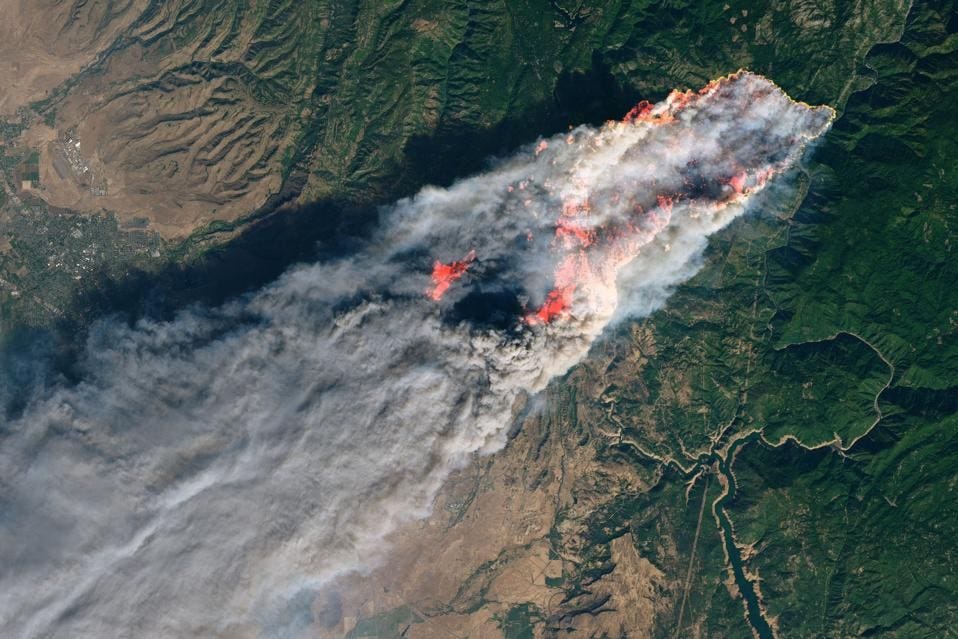
In 2018, a worn suspension hook on a transmission tower broke and dropped a high-voltage powerline onto combustible vegetation, sparking the Camp Fire, an inferno that razed the town of Paradise, California. One rusty hook ended up killing 85 people, destroying more than 18,000 structures, and causing an estimated $16.5 billion in damage.
Large wildfires not only wreak havoc on communities; they also further unbalance the earth’s carbon cycle. Earlier this month, NASA reported that the 2023 summer fires in Canada released around 640 million metric tons of carbon dioxide into the atmosphere—roughly equivalent to the annual emissions of an industrialized nation.
The California startup Buzz Solutions is harnessing technology to act as a force multiplier for grid operators struggling to maintain their transmission and distribution systems in a drier, more combustible post-climate world. Their success will help prevent catastrophic grid failures, reduce utility rates, and protect homeowners from hazards and heartache.
Buzz Solutions uses proprietary AI algorithms to identify potential fire hazards and maintenance issues from images of power transmission and distribution infrastructure taken from drones, helicopters, and fixed-wing aircraft. When a potential problem is identified, the relevant image, tagged with GPS coordinates, is routed to the client utility’s maintenance system so the threat can be reviewed and categorized, and a crew dispatched to resolve the issue.
Buzz was founded in 2017 by Kaitlyn Albertoli and Vikhyat Chaudhry, who met at Stanford’s Launchpad accelerator. The firm has grown to a team of 28, raised a seed round from savvy investors, and is generating millions in revenues annually from large utilities across the U.S. The company plans to raise additional capital in early 2025 to expand its geographical reach.

Maintaining the expanse of the U.S. electrical grid—most of which was built in the 1960s and 1970s—is a daunting task. Grid operators have long carried out airborne inspections using conventional aircraft and recently have begun using drones to locate potential problems, but analyzing the images generated by those flyovers represents an impossible scaling problem for humans.
Transmission lines move high-voltage electricity over long distances from generating plants to substations. Substations “step down” high-voltage power into lower voltages, which are then delivered to homes and businesses using the distribution system. If transmission is like long-haul trucking, distribution is "last mile" delivery.
Our transmission system spans roughly 700,000 miles across the U.S. Its towers are typically tall and run over remote and often rugged terrain. Transmission equipment is prone to exposure damage—rust, corrosion, and mechanical problems caused by storms or fires. During the summer, when both temperatures and demand for power are high, lines sag and can short out on trees, causing fires.
Distribution lines, in contrast, cover around 5.5 million miles, delivering power to end users in more densely populated urban and suburban areas. The distribution system is vulnerable to outages or fires from vehicle collisions, fallen or overgrown trees, and wildlife like squirrels and birds.
The transmission system’s remoteness and the distribution system’s complexity essentially leave service crews’ ability to spot potential problems to chance. There are not enough crews to do more than spot-check all the lines. This is where Buzz Solutions’ technology serves as a force multiplier.
The National Interagency Fire Center has recorded an average of 70,000 wildfires annually in the United States since 1983, many of which—like the 2018 Camp Fire—are triggered by power line faults and infrastructure failures that are preventable with proper inspections and maintenance.
The increasing frequency and severity of these fires is concerning. Of the 22 wildfire events reported by NOAA to have each caused over $1 billion in financial damage between 1980 and 2023, 18 have occurred since 2000.
Buzz Solutions’ founders have been building out the company for nearly a decade. Albertoli, who oversees Buzz’s operations and strategy, started out in investment banking at JP Morgan. Wanting to make a greater real-world impact, she transitioned from Wall Street into sustainable food operations. While working in that field, she took Stanford’s Launchpad course, where she met Chaudhry.
Chaudhry leads technology development at Buzz. He has a background in AI and machine learning implementation in power engineering, having worked on smart grid initiatives at networking giant Cisco. His interest in the problems faced by our power grid compelled him to design a Launchpad project using drones to inspect wind turbines and powerlines.
Buzz developed its damage recognition algorithms and tested its aerial inspection methods from 2017 to 2019 before moving into the pilot stage with prospective customers from 2020 to 2022 and initiating commercial sales in 2023.
Buzz is revenue positive from agreements with notable firms such as PG&E, the NY Power Authority, and California Edison. This commercial traction helped Buzz close a seed round with backing from Go Point Ventures, Blackhorn Ventures, and Mac Venture Capital in the summer of 2020.
In addition to transmission and distribution-line equipment inspections, Buzz is also applying AI to the problem of unmanned substation maintenance and security. Its PowerGuard service provides real-time AI monitoring of facility intrusions and uses thermal imaging to spot temperature anomalies in substation equipment. Chaudhry says that the team is now working on applying thermal imaging analysis to transmission and distribution lines and equipment.

Buzz Solutions is not the only company to apply AI to problems of grid maintenance. Interestingly, we found that competitors were predominantly from Nordic countries. eSmart Systems, a Norwegian company founded five years before Buzz, and a Swedish company called Arkion offer similar AI-based analyses of grid infrastructure. Chaudhry believes that this geographical concentration resulted from more forward-thinking regulatory environments in Nordic countries that allowed drone-based inspections to take off earlier there than in the U.S.
Chaudhry sees drone-based visual inspections as a cheap, safe, and efficient way to equip the entire grid with Internet-of-Things capabilities, but only if the information gathered can be analyzed and acted upon. While substantial AI knowledge and computing power are squandered on superfluous uses (e.g., Pope Francis in a puffer coat and a doghouse made of salmon rolls), this is one AI application with a clear promise to help humanity adapt to the realities of the post-climate world.
Intelligent investors take note.